Nan Fest 2026 What Nong Nam Krok Left Behind After the Festival Ended
972 Views |

Sometimes the best festivals are the ones that stay with us long after the lights go out.
Two grandmothers sat on a woven mat, faces turned toward the stage, laughing at something I couldn't quite catch. Beside them, a young couple cradled a sleeping infant. A teenager scrolled through his phone but kept glancing up at the performance. And above everything, a full moon hung in the dark sky — uninvited, but certain it belonged there, because it knew this night mattered.
I stood there for a while without reaching for my camera. I knew the photograph wouldn't capture what I was feeling.
That was Nan Fest 2026.
An Opening Scene No One Could Have Designed
On May 1st, 2026, at six in the evening, the sky above Ban Nam Krok Mai shifted slowly from pale blue to deep amber. String lights began to glow as the last of the natural light faded away.
Nai Chainarong Wongyai, Governor of Nan Province, stood at the podium against a backdrop that no stage designer on earth could have built — towering trees silhouetted black against a sky on fire, strings of warm bulbs stretching across the grounds, and the first notes of music rising just as the evening's first star appeared.
What he said that night didn't sound like an official speech. It sounded like someone who genuinely knows their city, explaining to newly arrived guests what Nan really is. He spoke of the artistic and cultural heritage that communities here have passed down across generations — but what struck me more was the tense he used. Not "once had." Not "used to be." But still is. And this festival was the proof.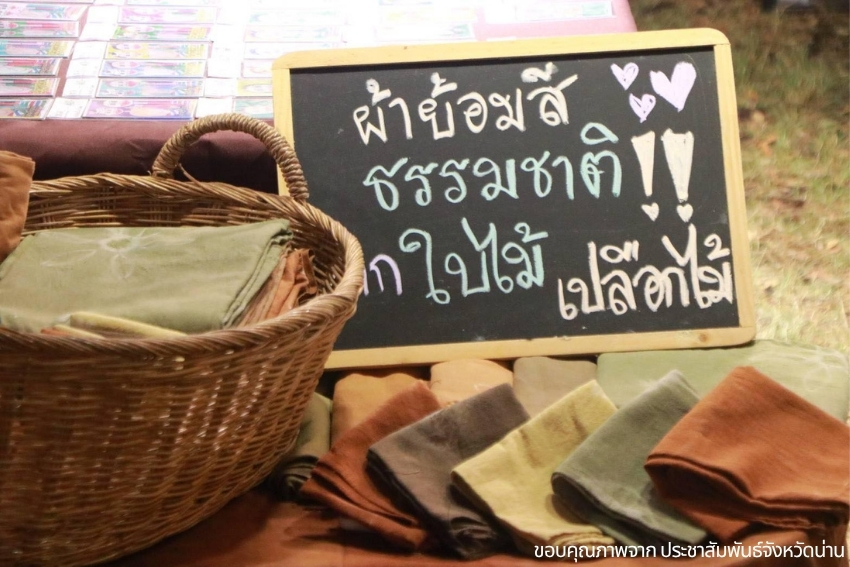
At the center stage, women in deep indigo and red traditional dress moved in rhythm, their hand-woven sinh skirts catching the breeze. This wasn't decorative performance. This was Nan introducing itself in the most honest way it knows how.
On stage during the opening, officials in formal dress stood shoulder to shoulder with artists in hats and t-shirts and community representatives. That image said something no government document ever could — everyone here has a stake. And "everyone" meant exactly that: from the Thai Media Fund and the Creative Economy Agency (CEA), all the way to the villagers who opened their doors to let complete strangers move in and make art.
The Tourist Tram and the Story Before the Story
Before seeing the festival itself, I spotted a bright green tourist tram parked along the roadside, its body printed with the Nan Fest logo in large lettering. The sign beneath read: Ban Phra Kerd.
The tram ferried visitors and locals between points across the village — but it felt like more than transport. It was a quiet signal that this event had thought about everyone: those who could navigate on their own, and those who might need a little help. Small details like this are how you know the people organizing the festival actually care about the people coming to it.
Art Floating on the Pond
In the afternoon, the surface of Nong Nam Krok caught the fading sunlight and turned it gold. In the middle of that stillness, two bamboo rafts drifted quietly.
The first was the Floating Shelter — a small corrugated-roof house sitting on a bamboo raft that looked simple but carried something heavy inside. It was designed by a collective of architects from D4D (Design for Disasters) in memory of Grandma Tiam and every villager who lost everything to the devastating floods of 2024. It asked all of us a question: how do we design our lives to live with water, rather than simply run from it?
The second raft was more vivid — a pyramid sculpture built from recycled car tires, decorated with mirrors and colorful baskets. When the evening light hit it, the reflection in the water became an artwork that no one had planned to make.
I stood there longer than I meant to, unsure whether I was looking at art or at a question floating on the surface of the water.
Art That Grew from the Ground Up
This year, art wasn't brought in to the village. It grew out of it.
Through the Artists in Residence program, groups of artists moved into actual villagers' homes and worked there for real. Abandoned houses became exhibition spaces. One house became a puppet-making stage where local children helped build the stories. Another opened itself as a space for conversation between artists and community members, asking quietly: do empty houses hold memories? And if they do, how do we take care of them?
Along the water's edge, a small bamboo stand held white fabric printed with fish, boats, and the Nan Fest logo in blue. The cloth moved gently in the wind against the shimmer of the pond behind it. It didn't look like a gallery display. It looked like a flag the village had planted to mark its direction.
Under a large tree by the road, paintings in a range of styles leaned against the trunk — oil landscapes, black-and-white ink drawings with handwritten poetry. In the branches above, sheets of white paper printed with Buddhist year numbers hung at intervals, as if the village were keeping its own ledger of memories.
And as evening fell, two large woven bamboo lamp sculptures began to glow along the waterfront — shaped like enormous mushroom caps, connected by a cord that curved down between them, as if they were quietly whispering something to each other in the dark.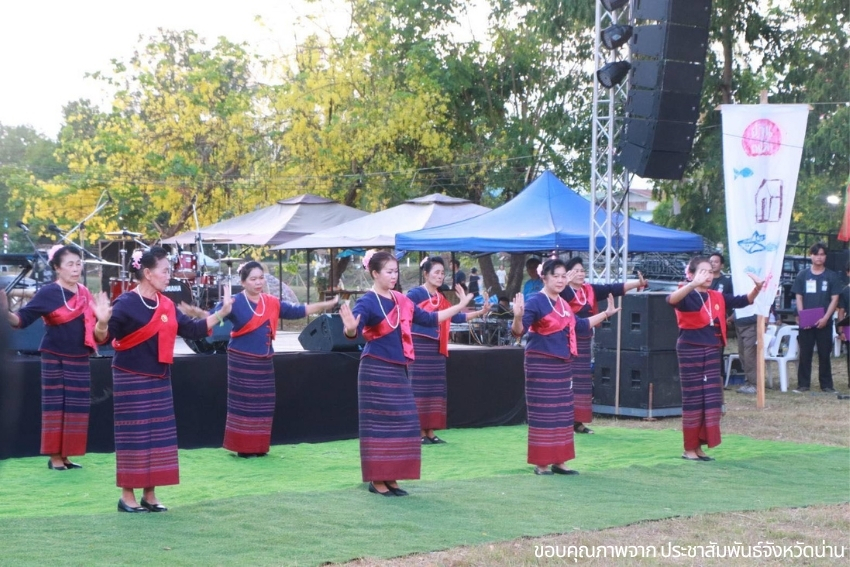
Natural Dyes and What Was Hidden in the Wicker Basket
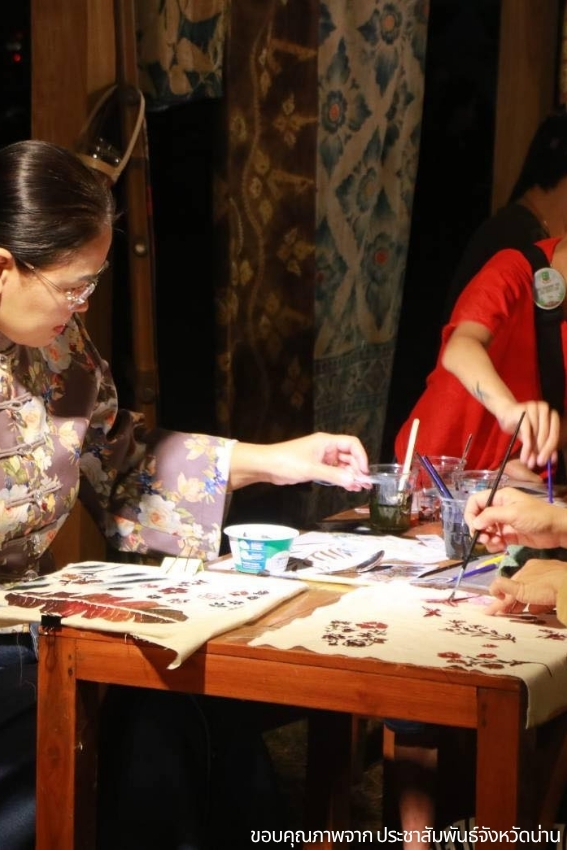
A small chalkboard written in pale blue read: Natural dye fabric!! Leaves. Tree bark. It sat in front of a booth so understated you could almost walk past it.
Inside a wicker basket, layers of fabric sat folded over one another — earthy beige, muted green, reddish brown. Every colour came from plants that people in Nan have known by name since childhood, but sometimes forgotten could do more than grow wild in the garden. The Governor had called this sort of thing "local cultural capital." But here in that wicker basket, it had weight. It had scent. And it had a price that told you someone was ready to pay to own a piece of it.
I bought one. Not because I needed it — but because walking away felt like declining something that deserved to be accepted.
Children and Clay That Was Still Wet
A small girl sat cross-legged at a low table, tongue pressed between her teeth, carefully painting a piece of unfired clay. Her mother sat beside her smiling quietly. Across the table, a young volunteer in a pale blue hat helped steady the brush for the girl who hadn't yet decided which direction to take the colour.
The ceramic-painting workshop looked like a small thing. But it showed me something important. This event wasn't designed for tourists. It was designed for that girl and her family — for people who may have never walked into an art gallery in their lives, but today got to sit down and make something with their own hands.
That is the clearest definition of "creative economy" I've ever encountered — not measured in revenue figures alone, but in what an ordinary person carries home in their head and in their hands when the day is done.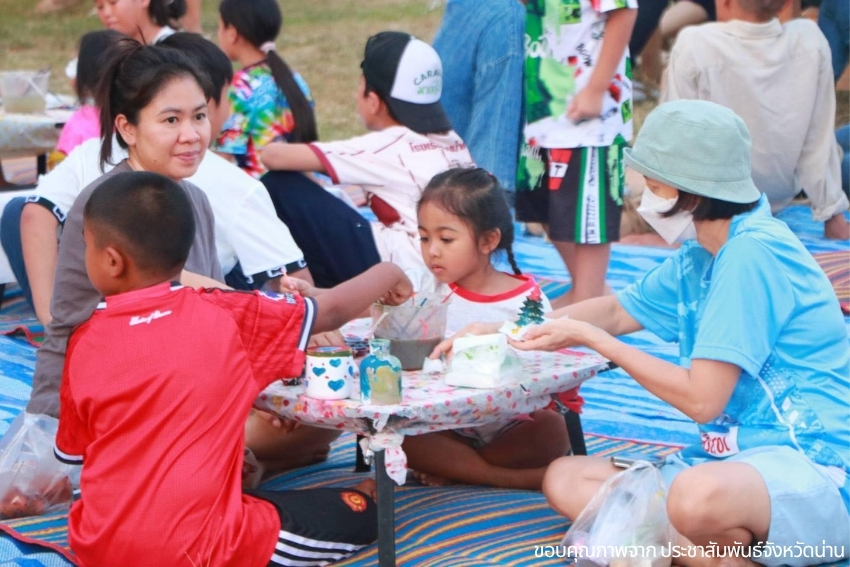
An Evening Beneath the String Lights
When night settled completely, Ban Nam Krok Mai became something difficult to name. Eventually I gave up trying and just called it what it was: a large, informal family party — not too formal, not too chaotic, and surprisingly warm.
String lights draped across the entire grounds created a canopy of soft light above the crowd. Families spread mats on the grass. Children wove between adult legs. Young people shared food on plastic chairs. Elders sat back in their seats watching the stage with expressions that said they were reasonably satisfied with life.
Nearly twenty food stalls sold out before ten o'clock, even as people were still streaming in. That's not a statistic — that's the honest answer to the question of how many people actually showed up.
And later, when the band took the stage, the view from behind the performers was something I suspect I'll carry for a long time: musicians facing out toward hundreds of people, and above every single head, a full moon that had arrived without an invitation because it knew it was exactly the right place to be.
What Gets Measured After the Music Stops
After the festival ended, the team at Salakid shared something that Dr. Chatri had said: Nan Fest was never designed for just one kind of person.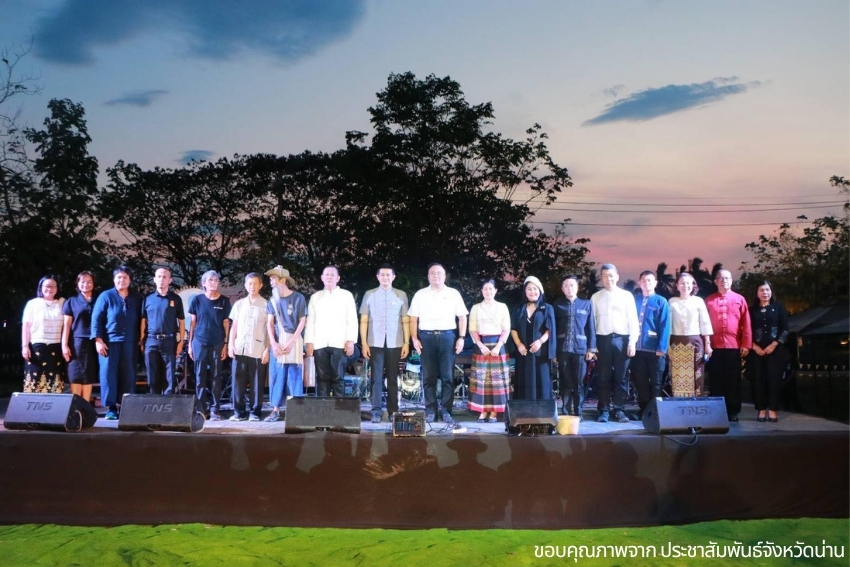
The first and most important group was the community. Villagers had to be genuinely involved — and crucially, they needed to earn more income as a result. The stalls that sold out by ten o'clock weren't just a sign of a successful event. They were evidence that the people of Ban Nam Krok Mai went home with something real.
The second group was artists, creatives, and exhibitors. The team wanted them to meet each other, talk, and build connections that might grow into future collaborations. I watched this happen across the festival — Thai and international artists deep in conversation by the pond, craftspeople and designers exchanging contacts after browsing each other's booths. None of that was in the program. It happened because the space was designed to let it.
The third group was the devotees — people who come every time Nan Fest is held, without fail. Many had traveled from other provinces. Some had booked accommodation weeks in advance. Some came without any accommodation at all. They weren't there because of a nice poster or a good review. They were there because they'd been before, and they knew it gave them something they couldn't find anywhere else.
All three groups shared the same field that night. A grandmother on a mat next to someone from Bangkok. An art student from Chiang Mai in conversation with a village weaver. Children playing between the legs of strangers. And everyone feeling, somehow, that they were exactly where they should be.
After the Lights Go Out, It Isn't Over
The Governor said on opening night that this festival wasn't just a tourism event, but a stage for building connection between visitors and place. When I heard it, I wasn't sure how much I believed it. But days later, thinking about the villagers who earned a little more, the artists who finally met each other, and the devoted followers who drove across the country for something money can't buy — I understood that he was right.
A creative city isn't built with awards. It isn't built with policy. It's built every time an artist sits down cross-legged on the same mat as a villager. Every time a child puts colour on wet clay for the first time. Every time a fabric dyed from leaves and bark moves from a wicker basket into someone's hands. And every time a person makes the drive to Nan because they know that what's waiting there cannot be found anywhere else.
Ban Nam Krok Mai already knew the answer. Nan Fest 2026 simply helped everyone else come and find it — and leave carrying a little piece of it home.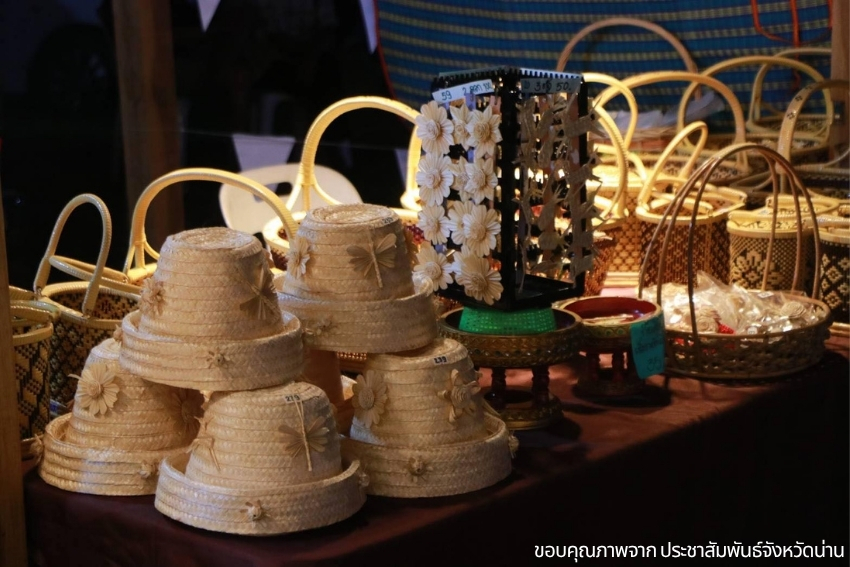
Nan Fest 2026 was held from May 1–3, 2026, at Ban Nam Krok Mai community, Tambon Kongkwai, Mueang District, Nan Province. Organised by Salakid Co., Ltd. (Social Enterprise). Supported by the Thai Media Fund and the Creative Economy Agency (CEA). Follow Nan's journey as a UNESCO Creative City at nancreativecity.org


